Basalt

An interactive terminal picker for a Bazel monorepo's targets — build, test, run and edit from one view.

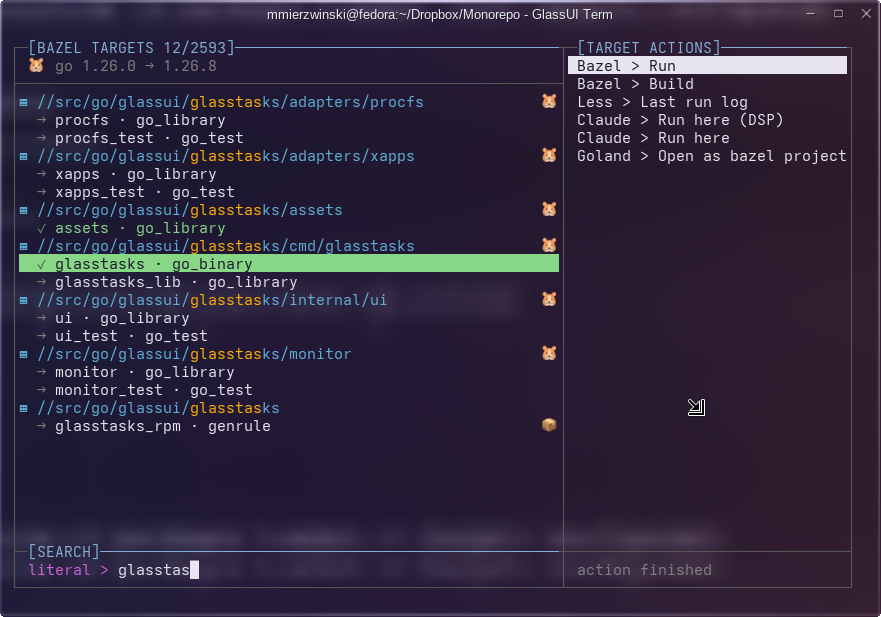
basalt makes a large Bazel monorepo navigable from the terminal. Typing basalt opens a three-panel view: the targets on the left, the actions available for the selected target on the right, and a search field below. Every keystroke refilters; Ctrl+R switches between literal and regular-expression search.

A tree, not a list

Each Bazel package heads a group in its own colour, with that package's targets indented beneath it. Filtering keeps the shape, so it is obvious where in the monorepo the matches live.

Actions that fit the target

  • A binary offers Bazel > Run, a test offers Bazel > Test, every rule offers Bazel > Build.
  • The Markdown files in the target's directory each become a Nano action.
  • Claude Code can be started in the target's directory, with or without the permission bypass.
  • GoLand and CLion appear for Go and C/C++ targets when those IDEs are installed, and are simply absent when they are not.

Choosing an action hands the terminal to it and takes it back when it exits, so one basalt session covers a whole build-edit-test loop. After a bazel command basalt reports the outcome and waits for Enter, so the output can be read before the interface paints over it.

The outcome is remembered: a target that passed is drawn green, one that failed red, and its output is kept so Less > Last run log can show it again later.

Requirements

Fedora x86_64 (a pure-static binary with no library dependencies), bazel on $PATH, and $MONOREPO set to the absolute path of the checkout. The target index is built by bazel query and cached as readable JSON under $MONOREPO/basalt_target_cache.

Install on Fedora

Add my package repository once (Fedora 41+ / dnf5):

sudo dnf config-manager addrepo --from-repofile=https://mattmierzwinski.com/fedora/mattmierzwinski.repo

Then install (and later update) the package like any other:

sudo dnf install basalt

On older Fedora with dnf4: sudo dnf config-manager --add-repo https://mattmierzwinski.com/fedora/mattmierzwinski.repo

Or download the RPM manually

Dependency tree

basalt pulls following dependencies:

Read straight from the package's RPM headers. A library required at several symbol versions is listed once, with those versions nested beneath it. Dependencies this repository provides are expanded; the rest are satisfied by Fedora itself and shown as leaves, because resolving those would mean mirroring Fedora's own repositories.

Changelog

[0.6.0] — 2026-08-16

Added

  • A portable tarball, //src/go/tools/basalt:basalt_tgz, alongside the RPM — for distributions where an RPM is no use. There is deliberately no AppImage: AppImage exists to carry heavy runtime dependencies, and a pure-static terminal binary has none to carry.
  • basalt is published at github.com/mateuszmierzwinski/basalt, as a source mirror plus the release artifacts. ./export_to_github.sh regenerates it and EXPORT_TO_GITHUB.md is the procedure. Development stays in the monorepo; the mirror carries no history and accepts no patches.

Changed

  • Each toolchain gets its own frame in the header. They previously ran together on one line, which read as a single sentence — 🔧 gcc/g++ 16.1.1 🐹 go 1.25.8 → 1.26.5 invites you to parse it as one statement about one thing. They are now separate cells divided by a rule, closed off from the target list beneath, with the panel border above carrying the connector. A package written in one language gets one full-width frame.
  • A toolchain the host cannot satisfy now reddens only its own cell. The whole header used to turn red, which said "something here is wrong" without saying which compiler — and reddened the C frame for a Go requirement it has nothing to do with.
  • The header belongs to the target column, so the action panel keeps filling from the top of the frame rather than losing rows to it.
  • Test fixtures name invented projects — falcon, mixer, probe — instead of the monorepo's real ones. A test has no business depending on a sibling project's name, and it is what lets the public mirror ship its tests unedited.

Rebuilt — 2026-09-28

  • The published 0.6.0 package was built with Go 1.26.0, fsnotify 1.9.0 and golang.org/x/sys 0.47.0. These updates landed after this entry was first written and are reconstructed here from Git history (commits 202d89a1, 7c914700). No change in behaviour.

[0.5.0] — 2026-08-16

Added

  • Bazel > Test package. A library or a binary now offers to run the tests that cover it. Tests almost never live in the same Bazel rule as the code they test, so the old rule — offer Bazel > Test only when the selected target is itself a *_test — meant a project with a full suite looked untested from every target except the test rules themselves. The new action runs bazel test //<package>/..., so it reaches tests in subpackages beneath the selection. It is offered only when there is something under the package to run, and a test rule keeps its own precise action instead of being offered both.

Changed

  • The target cache and the run history are portable between checkouts. Both recorded the absolute path of the monorepo they were written in and refused to load anywhere else, so the same tree synced to two machines — where $MONOREPO points at a different directory on each — invalidated its cache on every switch and lost its run history entirely. Neither file holds an absolute path now: entries are Bazel labels, which are workspace-relative by construction, and a log is recorded by name rather than by path. Both schema versions are bumped to 2, so the existing files are discarded once and rebuilt.

Security

  • Dropping the recorded root removes a check, so the guarantee it was standing in for is now made where it belongs: every label is re-resolved against the running monorepo root on load, and every log name is resolved against the running cache directory and refused unless it is a bare file name landing inside it. A cache or history staged from anywhere else still cannot name a path outside this tree, and the CVE suite asserts exactly that rather than asserting that foreign files are rejected.

[0.4.0] — 2026-08-15

Added

  • Markers on every row. A package heading is led by ▦, and each target by its last outcome: ✓ passed, ☠ failed, → never run. The state of the tree is now readable without relying on colour at all, which matters on a terminal with an unusual palette as much as it does for colour-blind readers.
  • The unrun marker is grey but its target's name is not: most of the list has never been run, and greying all of it would make the rows carrying no news harder to read than the few that do.
  • Languages on package headings. A heading is suffixed with what its targets are written in — 🐹 for Go, 🔧 for C and C++ — in alphabetical order, so a package holding both reads 🔧 🐹.
  • A toolchain header. Above the list, basalt reports what the selected package needs against what this machine has: 🐹 go 1.25.8 → 1.26.5 for Go — the go directive of the nearest go.mod above the target, not a repo-wide guess — and 🔧 gcc/g++ 16.1.1 for C. A version basalt cannot determine shows as ?, which is deliberately different from showing nothing. When the host Go is older than required the whole line turns red.
  • Packaging targets are marked with 📦 — an RPM, TGZ, AppImage or tarball target. Building one is a different act from building a binary, and the list now says which is which.

Changed

  • Target rows no longer carry their own indentation — the marker does. Match highlighting is therefore measured against the target name rather than against decoration.

Fixed

  • The end-to-end suite inherited the developer's full PATH, so it saw whatever was installed on the machine. Symlinking GoLand and CLion into ~/.local/bin duly broke the case asserting that absent tools stay hidden — basalt was right, the test was not isolated. Fixtures now expose only their own bin directory plus /usr/bin:/bin.

[0.3.0] — 2026-08-15

Added

  • Run history. basalt remembers how each target's last bazel command went. A target that passed is drawn green, one that failed red, and one that has never been run is left plain — "no news" and "passed" must not look alike. The colour survives the selection highlight, because the target you just ran is the one under the cursor.
  • Less > Last run log. A bazel command's output is captured to a file as well as shown, so it can be read again later — coming back to a failure once you have looked at the code, or checking what a build actually said an hour ago. The action appears only when there is a log to read.
  • The history and the logs live beside the target cache under $MONOREPO/basalt_target_cache, and survive restarts. One log per target, overwritten on each run, so the directory stays bounded.

Changed

  • Capturing output means bazel's stdout is a pipe rather than a terminal, so it prints plain lines instead of its curses progress display. The trade is deliberate: everything is still visible as it happens, and the saved log is readable afterwards instead of a screenful of cursor movements.

Security

  • The run history is JSON in the repository, and the log path it names is opened in a pager — so it is treated as untrusted input, exactly like the target cache. A log path outside the cache directory is refused, and the check is re-asserted at the point of use rather than trusted from load time. A history from another checkout, another schema version, or with an entry filed under the wrong label is discarded whole.
  • Log file names are derived by flattening the label to [A-Za-z0-9-] and appending a digest of the original, so a hostile target name cannot steer the path and two labels that flatten alike still get separate files.
  • Captured logs and the history are written 0644 — never group- or world-writable, since build output can carry paths and environment detail.

[0.2.0] — 2026-08-15

Added

  • The target list is a tree. Each Bazel package now heads a group, drawn in its own colour, with that package's targets indented beneath it — named without repeating the path and tagged with their rule kind. Filtering keeps the shape rather than flattening it, so it is obvious where in the monorepo the matches live. A query matching a path highlights the heading; one matching a target name highlights the target.
  • Bazel actions wait before returning. After a build, test or run, basalt reports the outcome and holds the screen with Press Enter to return to basalt…, so the command's output can be read instead of being wiped by the next frame. Escape and Ctrl+C dismiss it too. Editor and IDE actions do not pause — they are quit deliberately and leave nothing to review.

Changed

  • Arrow keys, Home/End and paging move between targets and step over the package headings, which are labels rather than choices. The heading a selection belongs to is kept on screen while scrolling.

0.1.0 — 2026-08-15

First release.

Added

  • Three-panel picker over every Bazel target in the monorepo: the target list, the actions available for the selected target, and a search field. Typing filters the list on every keystroke, whichever panel has focus.
  • Literal case-insensitive search by default; Ctrl+R switches to regular expressions. A pattern that does not compile leaves the previous results on screen and reports the error, rather than blanking the list while you type.
  • An action panel built from the target's rule kind and the tools actually installed: Bazel > Run only for binaries, Bazel > Test only for tests, Bazel > Build for every rule, a Nano > entry per Markdown file present in the target's directory, Claude Code with and without its permission bypass, and GoLand or CLion for Go and C/C++ targets.
  • Actions suspend the UI and hand over the terminal, then restore it when the child exits — so nano and claude are fully interactive and one basalt session covers a whole build-edit-test loop.
  • A JSON target index at $MONOREPO/basalt_target_cache, refreshed after a day, on F5, with -nocache, or when a BUILD file changes under $MONOREPO/src. The watcher is debounced, so a Dropbox sync of the tree does not cause a storm of re-indexing.
  • -index prints what was indexed and exits, for checking the setup without entering the UI.

Security

  • Target names, labels and file names are stripped of control characters before they are rendered. A hostile name cannot repaint the screen, retitle the window, or send a device-status-report request that the terminal would answer into basalt's own input.
  • Commands are executed as an argv, never through a shell, so ;, $(…), backticks and pipes in a target or file name are inert data.
  • Labels that resolve outside $MONOREPO are refused, and a target carrying one is offered no actions.
  • The cache is treated as untrusted input — it is a JSON file in the repository root that anyone with the checkout can edit. An entry whose display text disagrees with its label, or that points outside the checkout, is rejected and the index rebuilt. A cache from another checkout or another schema version is discarded rather than misread.
  • The terminal is restored on every exit path, including signals and a failed child process.

Known limitations

  • Linux only: the terminal handling talks to TCGETS/TCSETS directly.
  • The index covers //src/..., which is the tree the tool exists to navigate.

Built with technologies I love

This blog runs on open, proven tools — chosen for reliability, not popularity.